
Description
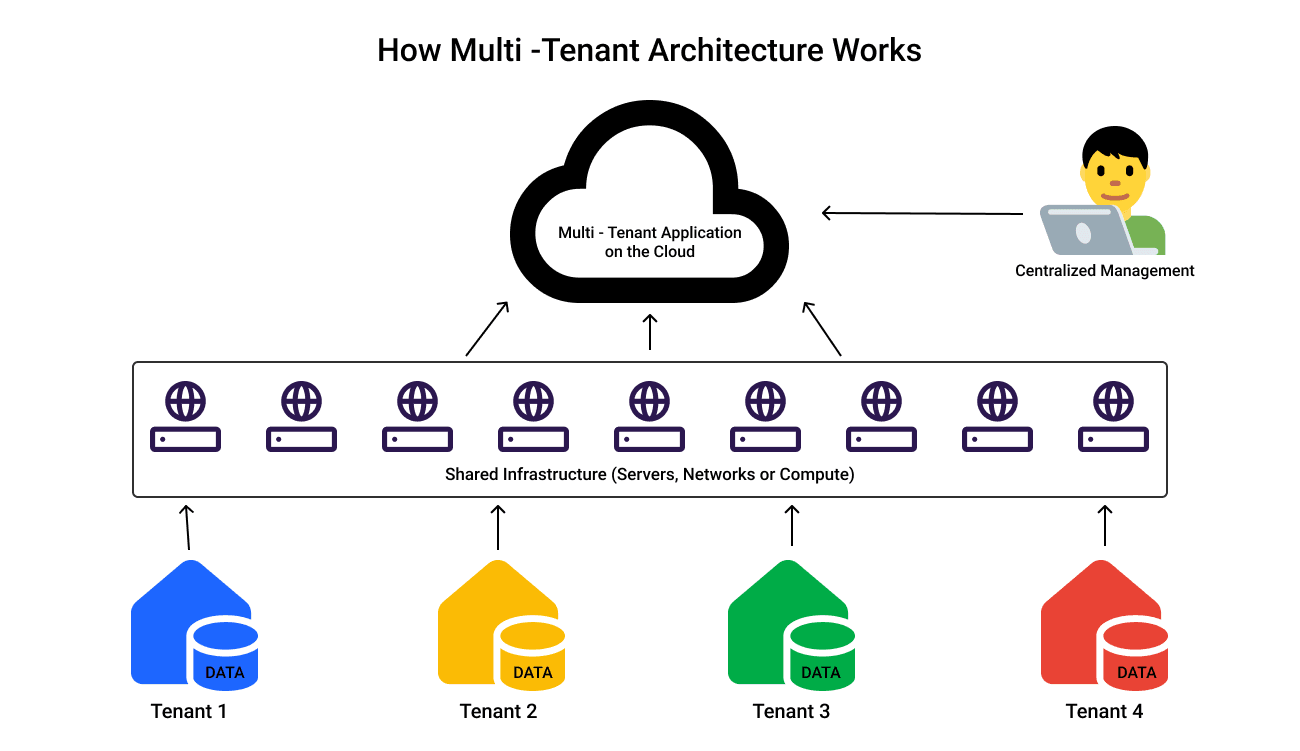
Multi-Tenant Architecture is a software architecture where a single instance of an application serves multiple independent user groups, called tenants. Each tenant’s data is isolated and remains invisible to other tenants, even though the same application instance is used.
-
Tenant: A group of users or an organization that shares access to the software.
-
Instance: A single running copy of the application.
2. Key Characteristics
-
Resource Sharing:
-
All tenants share the same software instance and underlying infrastructure.
-
-
Data Isolation:
-
Each tenant’s data is logically separated to ensure privacy and security.
-
-
Customizability:
-
Tenants can have customized settings, themes, or configurations without affecting others.
-
-
Scalability:
-
Supports many tenants without duplicating the application for each one.
-
3. Multi-Tenant Models
There are three common ways to implement multi-tenancy:
a) Database-Level Multi-Tenancy
-
Separate Database per Tenant
-
Each tenant gets its own database.
-
Pros: Strong isolation, easy backup per tenant.
-
Cons: Higher resource usage, harder to manage at scale.
-
-
Shared Database, Separate Schemas
-
One database, multiple schemas (one schema per tenant).
-
Pros: Balanced isolation and resource usage.
-
Cons: Schema changes affect multiple tenants.
-
-
Shared Database, Shared Schema
-
All tenants share the same database and tables, distinguished by a Tenant ID.
-
Pros: Efficient resource usage.
-
Cons: More complex queries and risk of data leaks if not handled properly.
-
b) Application-Level Multi-Tenancy
-
The application logic differentiates tenants.
-
Each request includes a tenant identifier, and the application serves data based on that.
c) Hybrid Multi-Tenancy
-
Combines database-level and application-level strategies.
-
Often used in large SaaS platforms for optimal performance and flexibility.
4. Advantages
-
Cost-efficient: Single instance reduces infrastructure cost.
-
Easier maintenance: Updates are applied once for all tenants.
-
Scalability: Can serve hundreds or thousands of tenants simultaneously.
-
Customizable for each tenant without duplicating code.
5. Challenges
-
Data security: Ensuring strict data isolation is critical.
-
Performance: Heavy usage by one tenant can affect others if resources are not managed.
-
Upgrades: Changes must be backward-compatible with all tenants.
-
Tenant-specific customizations: Over-customization can complicate codebase.
6. Use Cases
-
SaaS applications like Salesforce, Slack, or Shopify.
-
Enterprise platforms serving multiple clients.
-
Cloud-based services requiring centralized management but tenant isolation.


Reviews
There are no reviews yet.